You know the feeling. You’re sitting in the data center, the air conditioning is humming that deep B-flat that only sysadmins find soothing, and you’re staring at the dashboard. Everything is green. It’s a dangerous moment. Because that’s exactly when the little devil on your shoulder whispers: “Go on, Ubuntu 26.04 LTS is out. Just one little click on do-release-upgrade. What’s the worst that could happen?”
Answer: Everything.
The “Resolute Raccoon” is here, but this raccoon isn’t cute. It has rabies. For this release, Canonical has taken the silk gloves off and deleted the word “backward compatibility” from the dictionary with a thick layer of white-out. This isn’t a normal upgrade; it’s a forced modernization with a sledgehammer. If you dive in blindly, you won’t be spending the evening of April 23rd with a cold beer—you’ll be restoring backups while your boss breathes down your neck.
I’ve dug through the beta notes and surveyed the first crash sites in the test environments. Here are the three landmines waiting for you—sorted by the “Network Uncle Panic Index.”
The “Holy Grail” of sudo is gone: Welcome to the Rust Age
Panic Index: 7/10 (Painful for Enterprise Admins)
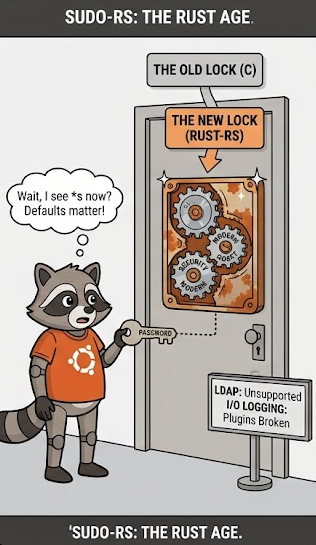
For what feels like 100 years, sudo has been the faithful bouncer of your system. A rock of C-code standing firm in the surf. But Ubuntu 26.04 has swapped that rock for sudo-rs. Yes, Rust. The new favorite toy of the security crowd. The good news: The key still fits the lock. The bad news: The lock cylinder has been replaced by a high-performance laser.
- The Asterisk Shock: When you type your password, you’ll suddenly see
***again. If you’ve spent two decades training your brain to type into a silent black hole, this is going to feel like someone moved all the furniture in your house while you were sleeping. - The Enterprise Neck-Snap: This is where it gets serious. If you use
sudowith LDAP backends, run complex I/O logging scenarios, or use obscure plugins that haven’t been touched since 2012—sudo-rs will give you the cold shoulder. The plugin API is new, and old plugins simply don’t fit.
Uncle’s Advice: Test your PAM configuration and your LDAP connection in an isolated VM. A “clear error message” from sudo-rs at 3:00 AM is technically precise, but it won’t bring your uptime back.
The “Raccoon Blockade”: Cgroup v1 is officially dead
Panic Index: 9/10 (The Ultimate Upgrade Killer)
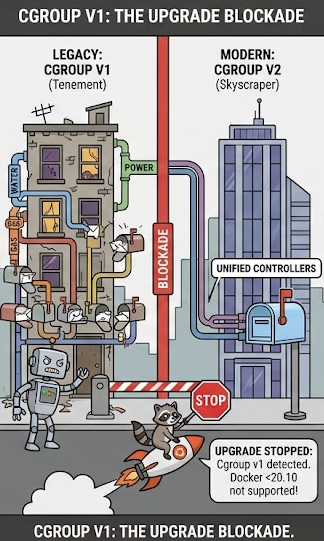
This isn’t a “maybe something will break” situation; this is a “the tool won’t even let you in” situation. The 26.04 upgrade script now has a built-in drug dog that sniffs for cgroup v1. If it finds it, it aborts the upgrade. Period. End of story. Why the radical step? Because systemd 258 pulled the plug. There is only the Unified Hierarchy (v2) now. If you’re thinking, “Oh, I only run a few containers,” then look closer:
- Docker Corpses: Anyone still running Docker versions older than 20.10 is in for a shock. They simply won’t find the path to the kernel anymore.
- Kubernetes Dinosaurs: Clusters provisioned before 2022 where
kubeletis hard-coded to v1 will just stand still after the upgrade. - LXC/LXD: Old containers with manually mounted cgroup paths? They’ll trash your file system on startup.
Uncle’s Advice: cat /proc/cgroups is your best friend. If there’s still a 0 next to the hierarchies, you’ve got homework. Migrate to v2 before you even look at the upgrade button.
The Great Oxidation: Your Shell Verbs have changed
Panic Index: 5/10 (Insidious like a creeping flu)
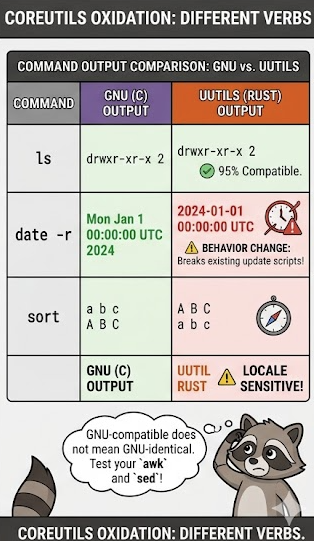
This is the subtlest but most dangerous part. ls, cat, mv, date—these are the core vocabulary of the Linux soul. Canonical has swapped the classic GNU Coreutils for uutils (written in Rust).
Think of it like this: You’ve been speaking English your whole life, and suddenly the government decides that as of tomorrow, we all speak a very specific dialect where 5% of the words have a slightly different nuance.
Parsing Hell: If you have 1,000-line Bash scripts that massage the output of ls -l or sort with awk and sed, you are in the dead zone. The uutils are about 95% compatible. That sounds like a lot, but in a world of a million script calls a day, a 5% failure rate is a statistical death sentence for your data integrity.
The date -r Disaster: We saw it in the Beta: the Rust command ignored a flag used by automated update scripts. Result? The machine thought it had just updated and left critical security patches lying on the floor.
The Uncle’s “Survival Guide” (Or: How not to get bitten)
I’ve watched admins cry since the days of Ubuntu 6.06 (Dapper Drake). Do it better this time. Follow the “Uncle Protocol”:
Step 1: The Inventory. Forget the new GNOME icons. Check your apt-key list. Anyone still using apt-key add is living dangerously—that is finally gone in 26.04.
Step 2: The X11 Funeral. GNOME 50 throws out the Xorg session. If you have NVIDIA cards and Wayland still flickers like a broken neon sign in a horror movie: Stay on 24.04. No joke.
Step 3: The Clone War. Clone your most important production VM into an isolated network. Fire the upgrade at it. Run your CI/CD pipelines. If it blows up, at least you’ll know where to bury the bodies.
Ubuntu 26.04 is a technical masterpiece—it’s fast, secure, and modern. But it’s like a sports car without driver aids: if you don’t know what you’re doing, you’ll end up in a ditch at the first corner.
So, who’s already seen their favorite script catch fire in the Beta? Give the Uncle a shout in the comments!